Think About It

These are the things you need to think about.

Category: Uncategorized

Words Matter

Words are powerful.  They can inspire and motivate. They can educate and enlighten.  They can express thoughts, ideas and emotions.  They form the basis of the written language through which we convey knowledge, understanding and truth. The subtleties in tone, inflection and nuance make a difference. Is it sarcasm or sympathy? Is it admonishment or encouragement?  What we say and how we say it matters.  And that is perhaps most evident in the context of our legal language.

Legislation and judicial decisions are the building blocks of a just society. The words that the legislators and justices use matter.  Our system of justice, our civil and criminal codes are all dependent upon the words these men and women choose to use. They are words that can emancipate and liberate or subjugate and oppress.  They are words that can protect and preserve our most fundamental human rights, or they can endanger and destroy them.

In 1857 the Supreme Court issued what historians agree was the worst decision in its history.  Dred Scott was a slave who sued for his freedom arguing that because he resided for an “extended period of time” in a state which prohibited slavery, the laws and jurisdiction of that state applied to him, and as a result, he was a free man.  Scott’s claim was based upon a precedent that had been upheld in both state and federal courts and should have been resolve at a lower level, but somehow managed to make it all the way to the Supreme Court where he lost in a 7 to 2 decision.

In writing for the majority, Chief Justice Roger Taney argued that because Scott was a member of a race that had been brought to this country as “property,” he and other black descendants were not citizens and subsequently not entitled to the rights and privileges guaranteed by the Constitution. The rights and privileges that according to the Declaration of Independence were endowed upon all men by their Creator. In other words, Dred Scott wasn’t a human being, he was “property.” “Property” that had no other purpose or function than to obey the will of its owner.

Words matter, and the words that were carefully chosen and crafted into the Dred Scott decision mattered. They denied millions of men, women and children their most fundamental God given human rights, justified and perpetuated the evils of slavery, further divided an already divided nation, and accelerated the inevitable confrontation which would result in the bloodiest conflict in our history.

In 1935, the German Legislature passed two carefully worded pieces of legislation; the Law for the Protection of German Blood and Honor, and the Reich Citizenship Law.  These laws were followed by several other directives designed to draw a distinction between true Germans or Aryans, and Non-Aryans or “sub-humans. These “sub-humans” included; Slavs, Poles, Serbs, Russians, Gypsies, and Jews.

Over the next seven years the Nazi’s used these carefully worded laws to strip these “sub-humans” of their dignity, property, citizenship, and civil and human rights. The culmination of these words occurred in January 1942 when 15 high ranking members of the Nazi party met at a villa in the Berlin suburb of Wannsee to draft their “Final Solution” to the “Jewish Question.” A solution that industrialized mass murder and killed over 11 million people. Words matter.

On January 22, 2019, Governor Andrew Cuomo of New York signed into law legislation designed to revise, amend and repeal provisions of the State’s Criminal Law relating to abortion.  New York Senate Bill S2796 legalizes late term abortions through the ninth month of pregnancy by using some carefully chosen words to redefine a “Person,” as a human being who has been born and is alive.  In other words, the New York State Legislature has decided that a child in the womb isn’t a person, it’s now a “non-person,” and since “non-persons” have no legal standing, those who seek and perform late term abortions are no longer criminally liable.

Although bill S2796 is very specific with the words it uses to define a “person,” the words it uses to justify a late term abortion are suspiciously ambiguous. Late term abortions are permissible to protect the patient’s “life” or “health.”  The word “life” is precise enough, but what about the word “health?” Does that refer strictly to the patient’s physical health or does it also include their mental, emotional or even financial health? Think about it. This bill gives medical professionals the authority to terminate a human life. Wouldn’t you think that the bill’s authors would want to be as precise and accurate as possible in specifying the circumstances when a late term abortion is permissible? Of course, that’s up to the New York State Courts to decide, but when you consider that a “non-person” has no recourse within the judicial system, it’s doubtful that the courts will ever hear that case. Words matter.

If the intent of S2796 were to guarantee access to a lifesaving medical procedure the sponsors of the bill would be familiar with the actual human tragedy which it addresses. They would have undoubtedly met with expectant couples who were faced with that excruciating and debilitating decision of having to choose between the life of the child and the life of the mother. They would be cognitive of the pain and anguish involved with having to make that choice and would be somewhat somber and humble in the passage of their regrettably necessary legislation. Yet when Governor Cuomo signed the bill into law, it was not met with the solemnity one would expect from an assemblage of compassionate and empathetic legislators. No, it was met by the resounding cheers and enthusiastic round of applause of a horde of anytime, anywhere, abortion on-demand activists.

First “property,” then “sub-human,” and now “non-person.” Yes, words matter.
 

From Many One

On May 20th, 1856, Senator Charles Sumner of Massachusetts delivered a fiery and impassioned speech denouncing the evils of slavery. Two days later, while working at his desk in the Senate Chamber, he was attacked by Congressman Preston Brooks of South Carolina. Without warning, Brooks savagely beat Sumner with a walking stick, until he collapsed to the floor bleeding and brain-damaged.

The country’s reaction was predictably polarized.  The Southern papers applauded the assault, saying that a good “thrashing” was the best way to deal with abolitionists.  The Northern papers rightly denounced it as a criminal act and an attack on the Freedom of Speech.  The incident is known as the end of “reasoned discourse,” the point of no return, the day that reason and debate gave way to passion and violence, sowing the seeds of an inevitable conflict.  Less than five years later, the United States would plunge itself into the bloodiest conflict in its history; a Civil War that would kill or wound one out of every twenty Americans.

Political discourse has always been a full-contact sport.  People are passionate about their views and the rhetoric often becomes contentious and nasty, but it must never rise to the level of violence.   Today, it’s suddenly 1856 again.  Our political dialog has deteriorated into an endless babble of name-calling and race-baiting.

A California Congresswoman encouraged her supporters to threaten, harass and intimidate members of the administration and their families when they’re out in public.  A former Secretary of State and Presidential Candidate insists that civility toward the opposition party must be suspended until her party regains power. A DNC spokesman openly called for violence against Republicans, and the people are listening.

A man in California was arrested for trying to stab a Congressional Candidate. An assault on two GOP candidates in a Minnesota restaurant left one with a concussion. In Washington DC, Representative Steve Scalise was shot and gravely wounded while playing baseball. And the violence is spilling onto the campuses and streets of America. Individual’s civil liberties are being routinely trampled by angry mobs who use shout-down tactics and violence to suppress the freedom of speech, and a patriot prayer gathering in Portland Oregon somehow provoked mass assaults and rioting. This country is literally losing its collective mind. There is no longer any civility in our political debate, all “reasoned discourse” has ended. What happened?  How did we get to this point? The simple answer is, “The Diversity Lie.”

The United States is the most diverse society on earth because it is the only nation in history that was designed and created for the individual. Think about it.  The Declaration of Independence espouses the truth that all human-beings are created equal.  The Bill of Rights enumerates the rights and freedoms of the individual. America is about the individual, not about the group.

Over the centuries, millions have immigrated here bringing with them their traditions, culture, and values, and we take the best of these and weave them into our national fabric.  However, it’s individual human beings that immigrate, not groups.  Individuals whom come not to supplant our culture with theirs, but to assimilate, to become Americans, to become a part of the only civilization on earth where the rights of the individual are more important than the power of the state. Our national motto is “E Pluribus Unum,” meaning from many one.  We are one nation, and one people, comprised of 325 million unique individuals united by the truth that we are all created equal. Our nation and our society will always be as unique and diverse as the individuals who call themselves Americans. However, this is not the diversity that the political class has been force feeding us for the past decade.  The diversity that they’re peddling is a ploy, nothing more than a smokescreen for “Identity Politics.”

Identity Politics segregates and groups people by race, gender, age, ethnicity and sexual orientation, into monolithic voting blocks.  It’s the cynical and manipulative way that politicians look at the world.  Why do they do it?  They do it because it’s easier to pander to a group than to persuade an individual.

If a politician can convince you that you’re a victim, that you’re a member of some marginalized, downtrodden and exploited group, they can become your champion, your defender and protector, and once that happens, they own you.  It is much easier for a politician to convince you that you’re a victim than it is for them to present a lucid, well-reasoned argument for why their ideas, plans and programs will work for the betterment of everybody. No, it’s far simpler to say that America is bad, and that you’ve been screwed, then it is to have real solutions that actually work. The purpose and truth of identity politics is that it divides people into groups and pits them against each other, so they are easier to manipulate and control.  It’s all about the power, seizing and keeping power.

Our country is more divided today, than any time since the Civil War because we are besieged by the trifecta of tyranny. A political class that has grown entitled and corrupt playing identity politics and catering to the special-interest groups that pay for their elections.  A progressive movement that is actively working to undermine the sovereignty of the United States and push us towards a one-world government which they’ll control.  And an electorate that has become too complacent and lazy to pay attention, and participate in a government of the people, by the people and for the people.

The extremes on both the right and left are rising in popularity because the status quo is failing.  The political class has isolated itself from the concerns of the American people and grown contemptuous of the very people they are elected to serve.  They care only about power and are engaged in a death-struggle to attain it and are plunging us into a civil conflict in which there will be no winner.


All Rights Aren’t Created Equal

The nomination of a Justice to the United States Supreme Court should always give us cause to re-examine the role of the Court in our Constitutional Republic.  A case can be made that of the three branches of Government, the Judiciary is the most independent and powerful.  Think about it. The Supreme Court gets to pick and choose the cases it hears; Justices aren’t elected; they’re appointed; they serve for life, and can only be removed by impeachment, retirement, or death. And in the history of the court, only one Justice has ever been impeached.

In 1804, Samuel Chase of Maryland, one of the original signers of the Declaration of Independence was impeached by the House of Representatives.  Supporters of President Jefferson claimed that his politics biased his decisions and attempted to remove him from office. They failed; Chase was acquitted by the Senate and remained on the bench until his death in 1811.  Instead of weakening the power of the Court as Jefferson hoped, the impeachment actually strengthened it by establishing the precedent of Judicial Review that affirms the Court’s power to void legislation it deems unconstitutional.

The Supreme Court is the ultimate authority on the rights, liberties and freedoms of the American people.  Its rulings set the precedent for all other courts to follow. Each Justice must balance the hierarchy of human and civil rights and strive to render a decision that is just, fair, and true. It’s an awesome responsibility, and a difficult and demanding task because not all rights are created equal.

The rights and freedoms that we enjoy as Americans are either expressed or implied. The rights of life, liberty and the pursuit of happiness are our most fundamental rights and are expressed in the Declaration of Independence.  Just as the freedoms of speech and the press are expressed in the Bill of Rights.  The freedom of choice, however, is not an expressed right because it doesn’t appear in either document.  It is an implied right because it must exist and is necessary if one is to exercise their right of liberty in the pursuit of happiness.

Rights are also either conditional or absolute.  Most rights are conditional.  That is, we are free to exercise them on the condition that it does not infringe upon the rights of another.  Subsequently, conditional rights can be restricted or temporarily denied.  The freedoms of speech and press are protected by the 1st Amendment, but a judge can issue a gag order restricting them to protect an individual’s right to due process.  However, the gag order must eventually be lifted, and the 1st Amendment Rights restored. Absolute rights cannot be restricted because once they are denied, they cannot be restored. The right to life is an absolute right.

The Supreme Court may be the final authority on our rights and freedoms, but it is not infallible. Over the years, it has chosen political expedience over truth, and rendered some extremely flawed and terrible decisions.  The Dred Scott decision of 1857, which ruled that African Americans, whether free or slave could not be US Citizens, is generally considered its worst. That was nullified by the passage of the 14th Amendment.  Plessy v. Ferguson in 1896, upheld legal segregation, but was overturned by Brown v. the Board of Education in 1954. Buck v. Bell in 1927, upheld the sterilization of people with intellectual disabilities, and Korematsu v. United States in 1944, upheld the internment of Japanese-American citizens during World War II.  Interestingly, neither of these decisions has been overturned. Another extremely flawed decision that will have difficulty being upheld is Roe v. Wade.

Roe v. Wade is the 1973 ruling that upholds a woman’s right to have an abortion. It’s flawed not because it upholds a woman’s right to choose, it’s flawed because how it defines a human being.

Roe v. Wade pits a woman’s conditional right to choose against an unborn child’s absolute right to life. A conditional right cannot infringe upon an absolute right.  A woman has the right to choose an abortion only up until the point in time when the fetus becomes a person and inherits its absolute right to life.  The ruling defines this as viability; the point in time when the fetus is “potentially able to live outside the mother’s womb, albeit with artificial aid.” The problem with this definition is that it is uncertain and ambiguous.  The definition that determines what is and is not a human being, and when the conditional right to choose can supersede the absolute right to life, cannot be uncertain and ambiguous.  It must be certain, universal, and verifiable. Viability is none of these.

In 1973, viability was generally considered to be around the 28th week of pregnancy.  Today however, because of advancements in medical technology, viability occurs between the 23rd and 24th weeks.  So, viability is dependent upon ever evolving and changing technology?  How can technology, or worse, an individual’s access to technology, be a determinate factor in what constitutes a human life? It can’t, it’s too uncertain.

In low-income countries, the survival rate or viability of preterm babies less than 28 weeks in gestation is below ten-percent, in higher-income nations it exceeds ninety-percent. Does a person’s country of origin, ethnicity, or socio-economic condition determine whether or not they’re a human being?  Of course not, because that’s not universal.

And how do we know the precise moment when a person becomes a person?  If we’re going to allow the conditional right of choice to infringe upon the absolute right of life, don’t we need to verify that the life in question is indeed not a viable person?  How do we do that? We can’t, viability is neither certain, universal nor verifiable, and it is not an acceptable standard for determining what constitutes a human life.

If the Supreme Court agrees to hear a challenge to Roe v. Wade the viability criteria will almost certainly be discarded.  The Court will then have to decide upon a new definition for human life. Both sides will make their case for what they believe constitutes a human life. The pro-life side will argue that life and personhood begin at conception. That a fertilize egg is a single-cell organism that contains human DNA, and therefor, a human life with the absolute right to life that the Court is obligated to protect. Abortion-rights advocates will argue that a fetus isn’t a person and doesn’t inherit its absolute right to life until it exists outside the womb independent from the mother at birth.  However, given the hierarchy of rights, the burden of proof will fall upon those advocating for the conditional right to choose over the absolute right to life. It will be a very difficult case to make and is why the left vehemently opposes any challenge to Roe v. Wade.

No one knows with absolute certainty when human life begins.  There are opinions, but as of yet, there is no certain, universal, and verifiable standard.  However, considering what’s at stake, aren’t we obligated to at least try to discern the truth?  Let each side present its case.  Let’s hear from the expert witnesses; the scientists, philosophers and theologians, and let’s arrive at a decision that is just, fair and true.  Now, if one side continually insists upon opposing anyone or anything that requires it to argue its case and defend its position, doesn’t that tell you everything you need to know? Think about it.

God Speaks

Co-host of “The View” Joy Behar stirred up controversy when she suggested that Vice President Michael Pence had a “mental illness” because he claims to talk to Jesus.  To my knowledge, the Vice President has never publicly asserted that he converses with Christ.  I’m sure he prays to God like most Christians do, but that’s not what “The View” was discussing.  They were responding to comments made about the Vice President by a TV reality show contestant.  So, there’s no need to make anything more out of this incident than what it was. This was not a condemnation of the spiritual practice of communing with God. And it wasn’t an in-depth theological discussion on the presence of the divine in the lives of believers. No, Ms. Behar obviously dislikes the Vice President and his politics, and simply couldn’t resist taking a shot at him. This is more about ratings than it is religion.  However, it does raise an interesting question.  Does God talk to us?

The practice of communing with God is inherent in all the great religions of the world.  Contemplation, meditation and prayer, the idea that we can open our hearts and minds to the Divine has been an integral part of the Christian tradition since its inception.

In 1205, Giovanni di Pietro di Bernardone was praying in the Church of San Damiano when a vision of Jesus appeared to him and said, “Francis, Francis, go and repair My house which, as you can see, is falling into ruins.” Inspired by the voice, Francis of Assisi renounced his life of wealth and privilege, took a vow of poverty and formed the Franciscan Order, which was instrumental in reforming and revitalizing the Catholic Church during the 13th century.

Between September 1946 and December 1947, Jesus appeared to a Missionary Sister teaching at a Loreto convent school in India.  In what she described as a “call within a call,” he instructed her to go out into the streets, live among the poorest of the poor, and attend to their physical and spiritual needs.  Mother Teresa of Calcutta formed the Missionaries of Charity, which today has more than 4,000 sisters and 100,000 lay volunteers, operates 610 missions in 123 countries, including; hospices and homes for people with HIV, leprosy and tuberculosis, soup kitchens, children’s and family counseling programs, orphanages, and schools.

Perhaps the most unlikely but important conversation with Jesus occurred on a dusty road just outside of Damascus. Saul of Tarsus, a Jewish Pharisee and the sworn enemy of the followers of an obscure rabbi from Galilee, was on his way to the city to arrest several of the heretics and return them to Jerusalem for execution, when he was knocked to the ground by a flash of light, and heard a voice saying,

“Saul, Saul, why do you persecute me?” “Who are you, Lord?” Saul asked. “I am Jesus, whom you are persecuting,” he replied. “Now get up and go into the city, and you will be told what you must do.”

The conversion of Saint Paul was perhaps the most pivotal event within the life of the infant church, because it was Paul, who brought the Gospel of Jesus Christ to the non-Jewish world.  Had it not been for Paul, Christianity would most likely have died out as an obscure sect of Judaism.

Over the centuries, there have been other apparitions of Jesus, but they are extremely rare. Which begs the question, why doesn’t Jesus appear to people more often? If he did, maybe more people would believe. Probably because those to whom Jesus has appeared are either Venerated, Blessed or Saints.  In other words, they have achieved a level of spirituality and holiness that the rest of us will never attain.  Also, I think God understands just how fragile we are, because a face to face encounter with Jesus would be absolutely terrifying. However, the fact that most of us will never attain sainthood doesn’t mean we can’t commune with God, because we can.

God is always polite; he’ll never talk over or interrupt you.  If you want to hear God, you need to learn how to be silent.  Not just stop talking, but you need to silence your own voice inside your head.  Empty yourself of your own thoughts, your own ideas, of the things that you think you know, and listen.  God speaks in a whisper.  You’ll never hear him if you’re too busy talking to yourself. If you can learn how to be silent and seek out God’s truth with an honest and sincere heart, you’ll hear him.

But how will you know that the voice you hear is God’s, and not just your own?  You’ll know because it will tell you things that you don’t want to hear.  It will tell you to be more compassionate, forgiving and loving than you want to be.  It will compel you to look at yourself in a way that will make you uncomfortable and ashamed, and it will present you with the truth about yourself that’s much too difficult to accept. However, the truth is always accompanied with the grace needed to accept it.

Grace is the flip side of a coin shared with truth, and for the truth to have any value, it needs to be accepted with the grace that accompanies it.  But grace is a gift, something that we’re free to either accept or reject.  If we try to accept the truth without grace, it will never be anything more than an intellectualized abstract concept.  However, if we’re willing to accept both sides of the coin everything changes.  This is the conversion of the heart.

The problem with most of us is that we want the truth but are unwilling to accept the grace needed to make it incarnate.  This is why the world never seems to change, and why there will always be infinitely more sinners than saints.


A Simple Theology

Every morning I read the paper and find myself fighting back a wave of sadness. There is literally no end to the depravity that infects the human being. Children tortured and abuse by their own parents, dozens randomly murdered in a market place, unfathomable atrocities committed in the name of God; it never ends. And to dismiss it as an aberration is being dishonest, because a simple survey of human history is enough to prove otherwise. Human beings are broken and corrupt creatures, mired in selfishness, and capable of inflicting unspeakable evil on each other.  It’s a truth that should be unbearable, but I long ago embraced a theology that helps me make sense of this senselessness.

God is the totality of all there is, and nothing exists above or apart from God. God continually loves creation into existence. We are part of that relationship of love because we are part of creation, and therefore, inseparable from God.

We are created as independent moral beings with a free-will, because free-will is an absolute condition of love. Love cannot be compelled because the essence of love is the voluntary sacrifice of self.  We are in a relationship with God because God is the creator, and we are the creation, and he continuously loves us into existence.  That is the inescapable truth of who God is and what God does. His most intimate desire is that we embrace his love and immerse ourselves into our relationship with him. However, because we are endowed with a free-will, we can choose the depth and the extent of that relationship; we are free to surrender to God’s love, or to deny him completely.

Creation exists inside the mind of God, and it’s our presence in creation that gives rise to our sense of self. We know we exist because we exist relative to the rest of creation. However, it’s also our sense of self or ego that creates an illusion of separateness; that is the notion that we can exist separate or apart from God. The human ego sabotages our relationship with God by devolving it into a clash of wills; our ego’s need to assert itself and rebel, and God’s desire to love us unconditionally.

God knows why he created us; he alone understands the purpose and reason for our existence. Life is simply our opportunity to discover that purpose, and we achieve true happiness only when we live a life that fulfills that purpose. However, if we delude ourselves into believing that our happiness is contingent upon breaking away from God, we will never understand why he created us, and will never truly be happy. True happiness, true freedom comes not when we resist God’s will, but when we surrender to it. Unfortunately, the human ego is compelled to deny the need of the divine, even to the point of self-destruction.

So, how do I know what God wants for me as an individual? Every human being is a distinct and unique part of creation that’s in an exclusive relationship with the Creator. No one else can share in or be a part of your relationship with God, because it is uniquely yours. But like any relationship, it requires the active participation of both parties.  You need to spend time with God and learn how to converse with him. That’s prayer; contemplation, meditation, immersing yourself in the divine.  As your relationship with God grows, so does your ability to discern his truth.  In other words, you’ll never know what God wants for you until you learn how to both ask and listen.

So, how do we know what God wants for us collectively?  We know what he wants because he’s already told us, “This is my commandment: love one another, as I have loved you.” But what does that really mean?

We believe that we have the prerogative to determine right and wrong, but that right belongs exclusively to God. However, our human ego compels us to reject this truth and set ourselves up as our own arbitrators of good and evil. We continually deny and reject God’s authority and love to assert our own self-assumed divinity. This is original sin, and the origin of all the sin that separates us from God.

Think about it.  We continually reject God and deny his love, yet he never stops loving us. In fact, he loves us so much that he became like us and all ways except sin, to reunite the human with the divine. God entered humanity in the person of Jesus Christ to provide us a pathway to reconciliation and salvation. As Jesus hung upon the cross, he looked to heaven and cried, “Eli, Eli, lema sabachthani.” “My God, My God, why have you forsaken me?”  This is the instant that Jesus willingly assumed the sins of the world upon himself.

Sin, the very thing that separates us from God was assumed by God. This is beyond human comprehension.  Christ, the Second Person of the Trinity, assumed the sins of the world upon himself. Tearing himself from the Father, he descended into hell, the void of God’s love, to deposit our sins, and rose again on the third day to proclaim our salvation. This is without doubt the ultimate sacrifice of self, the definitive act of divine love, and the very thing that gives purpose and meaning to our existence.

The only evidence that a Creator exists is creation itself, and although the evidence is overwhelming, it is not indisputable, because there are theories that can explain the creation of the universe without invoking a Creator.  However, those theories, like the very existence of God, can never be proven because they attempt to explain an infinite first-cause that exists beyond the boundaries of the space-time that limits the finite human mind. Believing or not believing in God is and always will be, a choice.  I choose to believe in God because I refuse to live in a universe that has no purpose or meaning.  I choose to believe in a loving, compassionate, and forgiving Christian God who will administer justice at the end of time, because both my heart and my head tell me, it’s true.


Mob Rule

Eleanor Roosevelt famously said that “No one can make you feel inferior without your consent.” Although that’s true, we sometimes respond to things reflexively.  We’re biological and emotional beings; someone says or does something, and we react. However, she’s correct when it comes to how we choose to let things affect us. If someone cuts me off in traffic, I can chase them down in a fit of rage, or I can let it go, which of course is what the law demands because getting cut-off no matter how infuriating it may be, doesn’t justify the use of violence.

Human beings tend to react in ways that provide some type of psychological or emotional benefit. If I don’t like someone, I’ll go out of my way to find fault with the things that they do as a way of justifying my dislike of them. People are very strange that way.

A recent protest in Charlottesville Virginia over the removal of a statue of Robert E. Lee left a woman dead and several others injured.  That violence occurred because there were people who went to that protest intent on causing violence.  Members of the Ku Klux Klan and Neo Nazis, as well as Antifa, came armed with clubs, helmets and masks.  You don’t go to a rally with a club, helmet and mask to peaceably articulate your point of view. Unfortunately, every society has anarchist and thugs that enjoy creating chaos and inciting violence, and they showed up on both sides in Charlottesville.

However, think about the object at the center of the controversy, the statue. It’s an inanimate object made of stone and bronze.  It has no magical or mystical properties to do anything to anyone. How then was it able to invoke such a violent reaction?

The Charlottesville statue was commissioned by Paul Goodloe McIntire in 1917. McIntire was a philanthropist and benefactor of the University of Virginia, who established the school of commerce and economics, as well as an endowment for the fine arts. He also commissioned statues of fellow Virginians Thomas “Stonewall” Jackson, Meriwether Lewis, William Clark, as well as the Booker T. Washington Public Park. He died in 1952, so it’s impossible to know what was in his heart and mind when he commissioned the statue of Lee, but perhaps he was simply a proud son of Virginia?

There are more monuments and statues commemorating the Civil War than any other conflict in our history.  This makes sense when you consider that the Civil War was our most destructive conflict, killing or wounding one out of every twenty Americans.  Each monument is unique, with its own history and legacy.  Some were erected to honor the memory of those who perished in battle. Others were erected as an act of defiance against the Civil Rights movement.  But again, they’re inanimate objects.  They have no innate and inherent meaning or importance.  The only meaning or importance they have is what we choose to give them.

We live in the age of victimization.  If you can claim aggrieved status, you can use it as a moral lever to force your will upon others.  If you don’t like what someone says, you can label it hate speech and suppress their freedom of speech.  If you decide that a 100-year-old statue is a symbol of white supremacy, you can destroy public property.  Today, just being morally outraged about something, anything, makes you a social warrior and justifies you intimidating, threatening, and infringing upon the civil rights of those with whom you disagree. And it is all politically correct, because it’s all done under the banner of social justice.

Perhaps it’s time for a lesson in both civility and civics.  You can’t suppress someone else’s freedom of speech no matter how disagreeable or hateful you find it.  That freedom is protected by the First Amendment of the United States Constitution. It is a cornerstone of the Republic and essential to living in a free society. You can’t vandalize or destroy public or private property because you deem it to be offensive.  You certainly have the right to be offended and can petition for its removal, providing you abide by the rule of law and work within the constraints of the democratic process.  And under no circumstances, can you ever resort to violence or even the threat of violence because you dislike someone else’s political ideology.  Being offended doesn’t make you a victim. Being offended is the price we all pay for living in a free society. If we continue to choose to be ruled by emotion instead of Constitutional principles, our country will descend into mob rule and anarchy.

Thomas Jefferson believed that the American Revolution was the start of a much larger movement that would sweep across the globe freeing the common man from the oppression and tyranny of the European Nobility.  France was next, but Maximilien Robespierre, and the Jacobins had more ambitious goals.  They set out to create a utopian society and placed political correctness and ideological conformity above the natural rights of man and individual liberty. The Revolution failed and France never came close to establishing a Constitutional Republic or the Rule of Law like the United States. Instead, the “Republic of Virtue” descended into mob rule and a reign of terror that claimed the lives of more than fifty thousand French citizens, and in the end even the “Incorruptible” Robespierre couldn’t escape the guillotine’s blade.


The Freedom of Speech

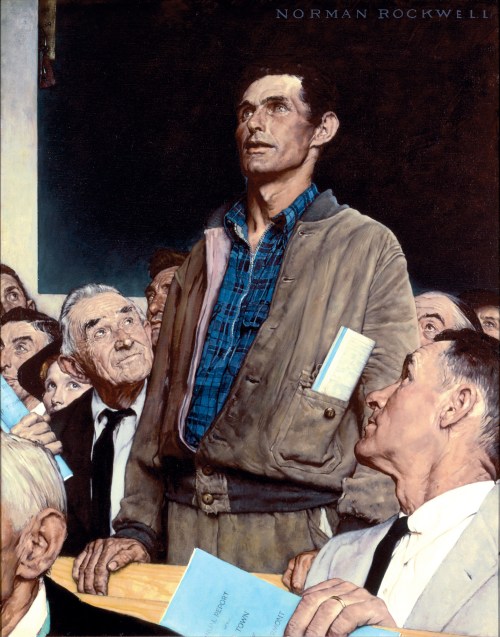
Norman Rockwell (1894-1978), "Freedom of Speech," 1943

Norman Rockwell (1894-1978), “Freedom of Speech,” 1943

Norman Rockwell was an American artist whose career spanned nearly six decades. His portfolio of over 4,000 works includes hundreds of covers for the Saturday Evening Post, Look Magazine and the Boy Scouts of America. However, his most acclaimed work came in 1943 when he was commissioned to paint the Four Freedoms. The Freedom to Worship, Freedom of Speech, Freedom from Fear and Freedom from Want appeared in the Saturday Evening Post along with essays from contemporary writers explaining the importance of winning the war. The paintings toured the United States as part of a War Bond Drive, and have become American icons.

Rockwell considered the Freedom of Speech his best work. It depicts a man resembling a young Abe Lincoln standing up at a New England town meeting. The sole dissenting voice fearlessly expressing his opinion as his detractors and critics respectfully pay attention and listen. It’s a powerful and moving image. Perhaps it’s time to remove it from the Rockwell Museum in Stockbridge Massachusetts, and again send it on tour to remind us what Freedom of Speech is supposed to look like.

Today, the America of Rockwell’s Freedoms is being replaced by a culture of group think and political correctness that is stifling individual liberty and freedom. On the American college campus, it is no longer safe to exchange ideas and pursue truth because higher education has been supplanted by the indoctrination of a progressive ideology that demands the absolute and universal conformity to one set of beliefs. The dissenting voice will not be tolerated. If you fail to parrot the progressive creed your grades will suffer; your opinion shouted down, and your physical safety threatened.

Manhattan Institute Scholar Heather Mac Donald was shouted down at UCLA and forced to flee under police protection from Claremont McKenna College. Rioters forced author and provocateur Milo Yiannopoulos to cancel his speech at U.C. Berkley. Professor Allison Stange was injured by Middlebury College Students intent on disrupting the lecture of author Charles Murray. And Evergreen College Professor Bret Weinstein’s refusal to comply with the demand that all white people vacate campus, resulted in him being labeled a racist and the demand for his termination.

Unfortunately, this is not a new phenomenon. For decades, students have been shouting down people like former Secretary of State Henry Kissinger, actor Charlton Heston, Israeli Prime Minister Benjamin Netanyahu, and even Supreme Court Justice Sandra Day O’Connor. However, what makes today’s campus behavior, particularly worrisome, is that it is being done with the approval and support of the progressive administrations that run our colleges and universities. There is no punishment for students who use intimidation or violence to silence those with whom they disagree. On the contrary, administrators routinely cave to the student’s demands, emboldening their efforts to silence any opposition to the progressive agenda. Over fifty faculty members of Evergreen College signed a letter supporting the student’s whose threats of violence shutdown the school.

The justification progressives give for subverting the First Amendment is their abhorrence of “hate speech.” Progressives consider themselves better educated and more enlightened than most, and believe that they are acting out of benevolence and compassion when they oppress someone else’s civil liberties. As the Wellesley College student newspaper stated, “If people are given the resources to learn, and either continue to speak hate speech or refuse to adapt their beliefs, then hostility may be warranted.” But what exactly constitutes hate speech? Well, when a church wants to quell dissent, they call it heresy. When a government wants to crush political opposition, they call it disloyalty. And when a progressive wants to silence an opposing point of view, they call it hate speech. In other words, hate speech is anything that challenges the progressive world view.

The only absolute right we have is the right to life. The rest of our rights are conditional, meaning they are contingent upon and limited by the impact they have on other people’s rights. I may have the right to listen to my music as loud as I want, but I don’t have the right to keep my neighbors up at night. However, the freedom of speech is about as close as you can get to an absolute right because it is a fundamental and inherent right, that is absolutely necessary in order for an individual to actualize themselves as a human being. Subsequently, the bar to restrict or limit the freedom of speech needs to be set extremely high. Speech can only be restricted if it insights violence or directly threatens the physical wellbeing of another person. Speech that upsets, annoys, aggravates, or even enrages us is protected by the First Amendment. Being offended, or having our opinions and beliefs challenged, is simply the price we pay for living in a free society. When it comes to the freedom of speech, there is no such thing as a safe-space.

Every human being is born with the innate desire to seek out and know the truth, and it’s our freedoms that enable us to pursue that truth. But the pursuit of truth is humbling because each step forward only reveals more of our inadequacies and limitations. Those who arrogantly claim to have a monopoly on truth probably haven’t spent a lot of time actually pursuing truth. The tell-tale sign that someone is wrong is their unwillingness or inability to engage, listen to, or debate someone with a different opinion. Those students who believe that they are entitled to suppress someone else’s freedom of speech, would be better served if they put down the megaphones and took a class on the United States Constitution.

Norman Rockwell was often ridiculed by contemporary critics. They said that his work was too idealistic and didn’t depict the grimy realities of American life. Instead, Rockwell chose to portray the more uplifting and even humorous aspects of American culture. Rockwell didn’t disagree with his critics and never referred to himself as an artist. He instead, referred to himself as an illustrator, depicting American life not as it was, but as it should be. Maybe it’s time to take another look at Rockwell’s Freedom of Speech?

Jane Roe

Norma McCorvey passed away at an assisted-living facility in Katy Texas on February 18, 2017. She was 69 years old.  By all objective measures, Ms. McCorvey had a difficult life; reform school, a teenage marriage that ended in divorce, an out-of-wedlock birth, financial hardship, and drug and alcohol addiction.  She was 22, unwed and struggling when she discovered she was pregnant for the third time. Unable to get a legal abortion in Texas, attorneys, Linda Coffee and Sarah Weddington, took her case all the way to the United States Supreme Court. The Court’s Roe v. Wade decision in January 1973, legalized abortion in the United States. Norma McCorvey was Jane Roe.

Later in life, Ms. McCorvey had a change of heart.  She became a born-again Christian, then a Roman Catholic, and a staunch pro-life advocate. Her conversion like her court ruling, remains mired in controversy, with each side of the abortion debate accusing the other side of exploiting her.

The abortion debate is contentious and emotional because it pits two fundamental human rights against each other; the right to life and the right to choose.  The most fundamental and basic of all human rights is the right to life.  It is an absolute right, meaning it is unconditional, there are no restrictions or limitations on it; no one can infringe upon or deny another person the right to life.  However, the right to choose is not an absolute right because it is conditional.  We are free to choose unless our choices infringe upon the rights of another person.  When that occurs, our freedom of choice is limited or restricted. This is the crux of the abortion debate; balancing a woman’s right to choose against an unborn’s right to life.

The right to have an abortion is not an absolute right, as Roe v. Wade acknowledges the State can regulate or prohibit an abortion after the point at which the life inside the womb becomes viable. “Viability,” is the actual term used in the Court’s decision. But what does that mean? “Viability” is the theoretical point in time where life can survive outside the womb, albeit with assistance. The problem with “viability” is that it isn’t an absolute. There are an infinite number of variables that determine the “viability” of a human life, including the quality of prenatal care and the ability to pay for that care. We can’t use “viability” as the determinant because it is too uncertain and discriminatory.  The determinant, the factor we must use in order to resolve the conflict of rights is, when does human life begin?

The human gestation period, from conception to natural birth is forty weeks.  The restriction clause of Roe v. Wade implies that there is a point during those forty-weeks when the life developing inside the womb becomes a human life, and that it’s at this point where the unborn’s absolute right to life supersedes the woman’s conditional right to choose.

So, when does that occur? When does, a life developing inside a womb become a human life?

I don’t know.  I know that at the instant of conception, a new life is created.  I know this because it meets the definition of life.  It’s a singled cell organism that takes in nourishment and metabolizes it. It grows, reproduces and functions.  So, it’s a life, but is it a human life? I don’t know. However, I do know that it contains human DNA, so without question it is a life of human origin. So, you could say it is a human life, but is a human life a person?  Does life of human origin developing inside the womb have human rights? I don’t know, but that’s the question we need to answer, isn’t it?

Abortion is and will continue to be an extremely controversial and divisive issue. I like most people, have my own opinions and beliefs.  However, I’m really not interested in opinions. I’m interested in the truth. Unfortunately, most people don’t seem to be all that interested in the truth. They really don’t want those questions asked, much less answered.  Try to broach the subject, try to have an honest debate or discussion about abortion, and you will be shouted down and vilified. Why? Is it because they’re afraid of what the answers might be? Do they prefer ignorance to truth?  Ignorance may be bliss, but it’s not an excuse. Eventually, we are all going to have to face the truth.  Whether it’s struggling with our own conscience, or standing before our creator, the truth will be revealed and we will be judged. The controversy will not end until we can answer those questions. Well, at least for Norma McCovery, the controversy is over, may she rest in peace.


Life

Life the movie, promises to be one of next summer’s box-office sensations. It’s about the six-member crew of an International Space Station that discovers the first proof of life beyond earth. The astronauts find a single-cell biological organism on Mars. However, as they begin experimenting with it, their methods have unintended consequences, and the life proves to be more intelligent and sinister than anyone expected.

Putting the science-fiction and computer-generated imagery aside, finding a single-cell biological organism on Mars would completely alter our understanding of life in the universe. Currently, there is no definitive, scientifically verifiable theory that can explain how life emerged in the universe. Of course, there are numerous theories. One theory says life emerged on earth more than 3 billion years ago when lightning struck a bubbling caldron of methane, ammonia and hydrogen, and created the amino acids that would eventually evolve into the first building blocks of life. Other theories say that life may have been organized in the clay, or grown on the backs of crystals. Regardless, there is no scientific theory that can adequately explain the origin of life in the universe. It remains a mystery.

So, if we don’t know how life emerged in the universe, what do we know?

Well, we know that the universe sprang into existence 13.7 billion years ago from nothing, and when we say “nothing,” we don’t mean an empty space or the absence of some thing. We mean the non-existence of everything; no space, no time, nothing. Now, that’s impossible to comprehend because there must be something, in order for the human mind to comprehend it. However, the universally accepted theory is that our universe sprang into existence from nothing with a big-bang. What came before the big-bang, and what caused the big-bang, is a matter of speculation? The religious say that the first cause, the only thing that always was, and always will be, is God. Others believe that our universe is part of a larger mega-universe that has always existed in some other dimension beyond our ability to see or know. However, even though science is unable to tell us what happened before the big-bang, it does have a good idea of what happened after the first instant of creation.

The big-bang was the sudden release of energy, a flash of light that emerged from a singularity of nothingness to create, and continues to create, the time and space that is the ever-expanding universe. Initially, there was only energy, but as time passed and the universe began to cool; the energy congealed to create the subatomic particles that would eventually combine to form the matter that makes up the stars, planets, and everything else that comprises the physical universe.

So, from nothing came light, from light came matter, and from matter came life. Somewhere along the way, what we call life, the biological organic matter that is alive, somehow emerged from the non-biological inorganic matter that was not alive. Life apparently, emerged from the dirt or space dust of the early universe, in a manner that is remarkably consistent with the creation story in the book of Genesis. Whether that story is a product of divine revelation, or simply the insight of common sense, is debatable. Although life is the rarest phenomenon in the universe, it is for us, unfortunately all too familiar.

Think about it. From the simplicity of single-celled organisms like bacteria, to the complexity and magnificence of the human being, life on earth is everywhere. It’s so abundant and diverse that we’ve become callous of its existence. We take it for granted simply because it’s here. What we fail to understand is that life doesn’t have to be here. In fact, life shouldn’t be here because the calculated probability that life should have emerged in the universe, the chances that inorganic matter should have spontaneously become organic and alive, is less than zero. Life should not exist, but somehow it does. Was it the result of some cosmic accident, or the byproduct of some intelligent-design? Again, that’s something for you to decide.

Imagine for a moment what would happen if we did find life on mars? The world would come to a literal halt. The attention of every human being on the planet would be focused on a single-cell organism growing in a petri-dish, floating in a spaceship, millions of miles away, simply because it was alive and wasn’t found on earth.

Yet, somehow when we find an even more advanced organism containing human DNA, taking in nourishment, converting it to energy, and growing; we don’t consider it a life. If we found it on Mars it would be the confirmation of life beyond earth, and the greatest discovery in human history. However, when we find it in a womb, it’s not a life? It’s an inconvenience, just some type of inorganic matter. In our modern secular society, how we define life, what we are willing to say actually constitutes a life, is more dependent  upon where you find it, than what it actually is?

“I can’t watch any more of this.”

America, has just endured the worst presidential race in history. It was a mean spirited, mud-slinging fist fight where policies and vision gave way to insults, accusations and smears. The debates were so embarrassing that I ended up turning off the television saying to myself, “I can’t watch any more of this.” It was a national disgrace capped-off by angry mobs taking to the streets, vandalizing private property and assaulting innocent bystanders. Civil discourse and the right to disagree are dead in America. Today, we look more like the Argentina of Juan and Eva Peron than we do the America of Abraham Lincoln and Stephen A. Douglas.

Never before has America been forced to choose between two such loathsome candidates. Donald Trump is a narcissistic buffoon, a self-promoting blowhard whose foul mouth and vulgarity regularly offends millions. Hillary Clinton is a corrupt liar, who deliberately circumvented the law, compromised national security, and abused her public office.

If Hillary Clinton had been elected; the United States may have found itself embroiled in a Constitutional crisis. The wiki-leaks emails indicate that Mrs. Clinton may have abused her position as Secretary of State and sold political favors for contributions to the Clinton Foundation. We won’t know the truth until the FBI fully investigates the foundation, but we could have found ourselves with a sitting President indicted for corruption. Additionally, National-Security experts know with absolute certainty that foreign governments hacked Mrs. Clinton’s email server. Meaning, if it exists, the enemies of the United States possess the incriminating evidence of Mrs. Clinton’s “pay-for-play” politics. The release of such information would throw the United States into a Constitutional crisis that would paralyze us, leaving us unable to respond to any further aggression by Russia into the Ukraine or Syria.

The election of Donald Trump means uncertainty and worry. Is the man taking the oath of office in January going to be the bigoted vulgarian we saw during the campaign, or the surprisingly humble and gracious man that gave his election night acceptance speech? If he chooses to be the obnoxious reality TV host, the American people will tell him in 2020, “Donald, you’re fired!” However, he is now the President-elect and only time will tell.

Should Americans be angry, should Americans be out in the streets protesting? Absolutely, but not because Donald Trump won the election and Hillary Clinton lost. We should be protesting because Clinton and Trump were the candidates, and because Clinton-Trump was the only choice, we had.

Think about it. Is this the best our country can do? How on earth did the most broken and corrupt candidates in US history secure the nominations of their parties? What happened?

What happened is that our political system is now so corrupt and broken that the only thing it can give us is broken and corrupt candidates. In ninety-eight percent of the elections, the candidate who spends the most on their campaign wins the election. And where do the politicians get the money to out-spend their opponents? It doesn’t come from the American people. The big money comes from the special-interests; the corporations, lobbyist, and other entities seeking political favoritism in return for financial support. Today, we have a political system in which politicians buy their office, and special-interests buy their politicians.

For more than three decades, people have been talking about reforming the system; implementing term limits, having publicly funded elections, and eliminating the PAC and special-interest money. But strangely, not a single candidate running for local, state or federal office made this an issue during the last election. Why? Because they don’t want to make it an issue, they don’t want to reform the system, they benefit from a broken and corrupt system. That’s why we get such broken and corrupt candidates.

People should be angry and out in the streets protesting a political system that no longer works for the benefit of the American people.  However, nothing is going to change until we put our ideologies aside, learn to engage in civil discourse without trying to destroy each other, and start working together to restore the integrity and impartiality of a self-governed Republic.